
Do you need help with an unpaid CCJ?
Struggling with an unpaid County Court Judgment (CCJ) from a business debtor? If you have a CCJ over £600 that remains unpaid, High Court Enforcement is often the most effective way to recover your money.
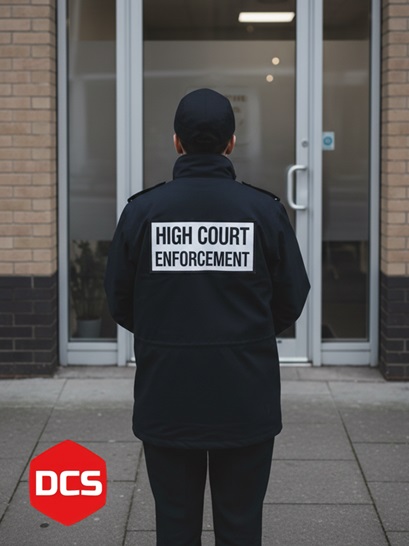
Why choose High Court Enforcement Officers (HCEOs)?
At Debt Collection Service Limited (DCS), we recommend High Court Enforcement when standard collection methods have failed. HCEOs, sometimes known as “Sheriffs”, have stronger legal powers than County Court Bailiffs—meaning they can act quickly and decisively to recover what you’re owed.
How does High Court Enforcement work?
Once a CCJ is granted, we can help you transfer it to the High Court for enforcement. This involves applying for a Writ of Control, which authorises HCEOs to visit the debtor’s business premises and seize assets if payment isn’t made. You may have seen this process on TV shows like “Can’t Pay? We’ll Take It Away!” or “The Sheriffs Are Coming”.
What’s involved in the process?
- Eligibility: The CCJ must be over £600 and relate to a business debt.
- Assessment: We review the debtor’s assets, vehicle ownership, mortgage status, and business structure to assess recovery prospects.
- Action: If we believe enforcement is likely to succeed with a HCEO, we guide you through every step of the process. If enforcement using a HCEO is not likely to assist, we will discuss with the client alternative options.
- Updates: You’ll receive clear, timely updates at each stage.
Why work with DCS?
Every case is different. We offer honest, tailored advice based on years of experience helping UK SMEs recover unpaid debts. Our due diligence ensures we only recommend High Court Enforcement when it’s truly in your best interest.
Get expert help with your unpaid CCJ
If you’re unsure what to do next with an unpaid County Court Judgment, contact our Bristol-based team for straightforward guidance. Using a HCEO may not be the best way forward, we will discuss the various options with you.
- Call: 0117 370 4236
- Email: office@debtcollectionservice.uk
Let us help you reclaim what’s yours.


Fees charged to the DEBTOR
The debtor [Judgment Debtor] will incur significant charges if a High Court Enforcement Officer is directed to collect a debt. The sooner a debt is paid, however, the less the added fees and interest will be. The fees are set by law in the Taking Control of Goods (Fees) Regulations 2014 (SI 2014/1894).
The recovery of a debt via a High Court Enforcement Officer is split into four stages, with fees assigned to each stage. These are set by law and added to the amount of the debt to be recovered.
Stage: Compliance
Fee: £75.00
This begins when a High Court Enforcement Officer receives an instruction to recover a debt and receives a sealed Writ of Control) from the Judgment Creditor.
The High Court Enforcement Officer will then send a ‘Notice of Enforcement’ to the person who owes the debt. The debtor then has seven days to pay the debt, any interest, court fees and the £75 compliance fee in full or the process moves to Enforcement Stage One and the additional fees set out below also apply.
Stage: Enforcement, Stage One
Fee: £190.00 plus + 7.5% of the debt value over £1,000
This begins if the person who owes the debt fails to make contact with the High Court Enforcement Officer or requests to pay by instalments during the Compliance Stage. An Enforcement Agent will attend their premises to take control of goods and may discuss payment options based on circumstances at this stage.
Stage: Enforcement, Stage Two
Fee: £495.00
This begins if the person who owes the debt:
- refuses to make payment and also refuses to enter into an acceptable agreement to pay their debt and fees in instalments, or
- makes and then breaks a legal agreement to repay their debt in instalments
Stage: Sale and Disposal
Fee: £525.00 plus 7.5% of the debt value above £1,000
Should enforcement get to the stage where the debtor’s goods need to be removed to pay the debt, then the ‘Sale and Disposal’ stage begins.
VAT at a rate of 20% may be added to the fees charged by the High Court Enforcement Officer. If the debt is a business-to-business debt, then the debtor will also continue to incur additional debt collection costs as stipulated by The Late Payment of Commercial Debts (Interest) Act 1998 s5A (2A), as amended by The Late Payment of Commercial Debts Regulations 2013 (SI2013/395). Potentially, due to the way fees are added to a debt, it could be that the HCEO is not aware of all the additional charges added to a debt. So further charges may be due from the debtor after the HCEO has taken payment from the debtor.
 | DCS | Debt Collection Service Limited |