
Download this page as a .pdf file

Credit Control Tips
for DCS clients and potential clients
Prevent payment problems before they start. These proven credit control strategies from our 20 years of debt collection experience will help you get paid faster and help avoid costly disputes.


Know exactly who you’re working with
Before starting any work, verify your client’s identity:
✓ Limited Companies: Search Companies House website for the exact legal name
✓ Sole Traders/Partnerships: Get full names of all proprietors/partners
✓ Contact Details: Confirm invoicing address and payment contact
Red Flag: If asked to invoice a different party, clarify in writing who is legally responsible for payment.
Why this matters: You can’t chase payment from the wrong entity. Get this right from day one.

Get Everything in Writing
✓ Provide written quotes: Include scope of work, all costs, VAT status, and payment terms
✓ Document every change: Client adds extra work? Client changes what they want? Log it immediately (even a WhatsApp message counts as evidence)
✓ Clarify site work details: Who removes waste? What prep work is the client responsible for?
✓ Keep Records: Maintain copies of all estimates, quotes, and agreed variations
Red Flag: Verbal agreements can lead to “he said, she said” disputes. Get it in writing, always.
Why this matters: Written records prevent payment disputes and help win court cases. No documentation can mean no proof.

Correspondence with your client

Every letter, email and invoice should include your full legal details:
Limited Companies:
✓ Full legal company name (exactly as registered with Companies House)
✓ Company registration number
✓ Registered office address
More info here
Sole Traders/Partnerships:
✓ Full names of all proprietors/partners
✓ Trading name clearly stated (e.g., “Jane B Brown & John C Smith trading as Brown & Smith Electrical”)
✓ Postal address (PO Box alone isn’t sufficient)
Why this matters: Missing business details can make your invoices legally invalid.

Create Bulletproof Invoices
Missing information = invalid invoice = can’t be legally “overdue”

Every invoice must include:
✓ Your full business details (see above)
✓ Customer’s full name and address
✓ Unique invoice number and date
✓ Clear description of goods/services provided
✓ Amount due (with VAT breakdown if applicable)
✓ Payment terms clearly stated
✓ Your bank account details for payment
✓ Payment reference instruction (e.g., “Please quote invoice number as reference”)
Review your invoice (and estimate) templates, and update accordingly.
Pro tip: Make it easy to pay you. Include all bank details and clear instructions. The harder it is to pay, the longer you’ll wait.

Enforce your payment terms – consistently
It is important to clearly state your payment terms in your correspondence with clients. Adhere to these terms consistently.
State your payment terms clearly, then stick to them every time:

Your Payment Process:
✓ Day Before Due: Send a friendly reminder email
✓ Few Days Overdue: Post a copy of the invoice prominently marked “OVERDUE”
✓ 7 Days Overdue: Follow up by phone
✓ 14+ Days Overdue: Consider instructing DCS to recover the debt
Red Flag: Inconsistent enforcement trains clients to pay you last. Don’t let payment terms become “suggestions.”
Why this matters: Clients who know you’ll chase payment promptly pay faster. Be the squeaky wheel—politely but persistently.
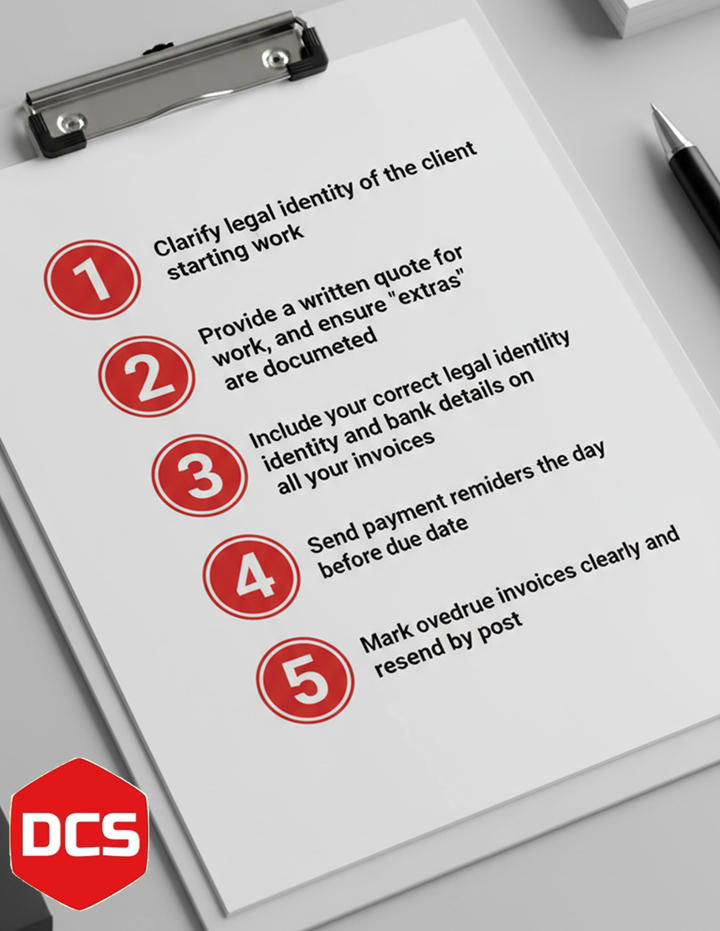
5 Quick Wins to get paid:
- Clarify the legal identity of the client starting work
- Provide a written quote for work, and ensure ‘extras’ are documented
- Include your correct legal identity and bank details on all your invoices
- Send payment reminders the day before due date
- Mark overdue invoices clearly and resend by post
Do you need help recovering late payments?
For twenty years we’ve been helping SMEs recover what they’re owed. We can help you too!
Contact us to discuss how we can help you …
☎️ 0117 370 4236
📧 office@debtcollectionservice.uk

 | DCS | Debt Collection Service Limited |